Mandalay Bay’s Shark Reef
This past May I delivered a few talks at the 2026 University & College Designers Association (UCDA) Education Summit in Las Vegas, so I took the opportunity to visit the only AZA-accredited site in Nevada, the Shark Reef Aquarium at the Mandalay Bay Resort and Casino. I had been once before, back in 2008, but it was a quick stop, and I only took a handful of mostly blurry photos. Most importantly, I did not yet have zoos on the brain.
This time I wanted to document the experience from the perspective of our new book, specifically through the lens of the section on staging through filmic grammar and how framing, pacing, and transitions are established and leveraged by designers.
It wouldn’t be the Las Vegas Strip without some neon, right? This is the first indication you see within the resort that the aquarium is up ahead.
Mandalay Bay is quite proud of the fact that it is fully accredited by AZA, and there is a very large sign to prove it. I imagine the resort is mindful of animal welfare, especially after Roy Horn of the Siegfried and Roy duo was mauled by a 400-pound white tiger on stage at the Mirage in October 2003. In fact, the institution received AZA’s stamp of approval just over six months before that incident.
The Shark Reef Aquarium opened on June 20, 2000 at a cost of some $40 million with creative consultation from the Vancouver Aquarium. Global engineering firm NV5 provided the electrical and mechanical design. About 900,000 people visit every year. Coming as it did a bit over two years after Disney’s Animal Kingdom debuted, the park’s design influence is acutely felt at each and every turn. Where the attraction really excels is in its dramatic and varied pacing. This processional begins by traveling upward via escalator, stairs, or elevator. Immediately I have left the environs of the hotel casino floor and am enveloped in themed stone walls. It appears to be some kind of ancient temple.
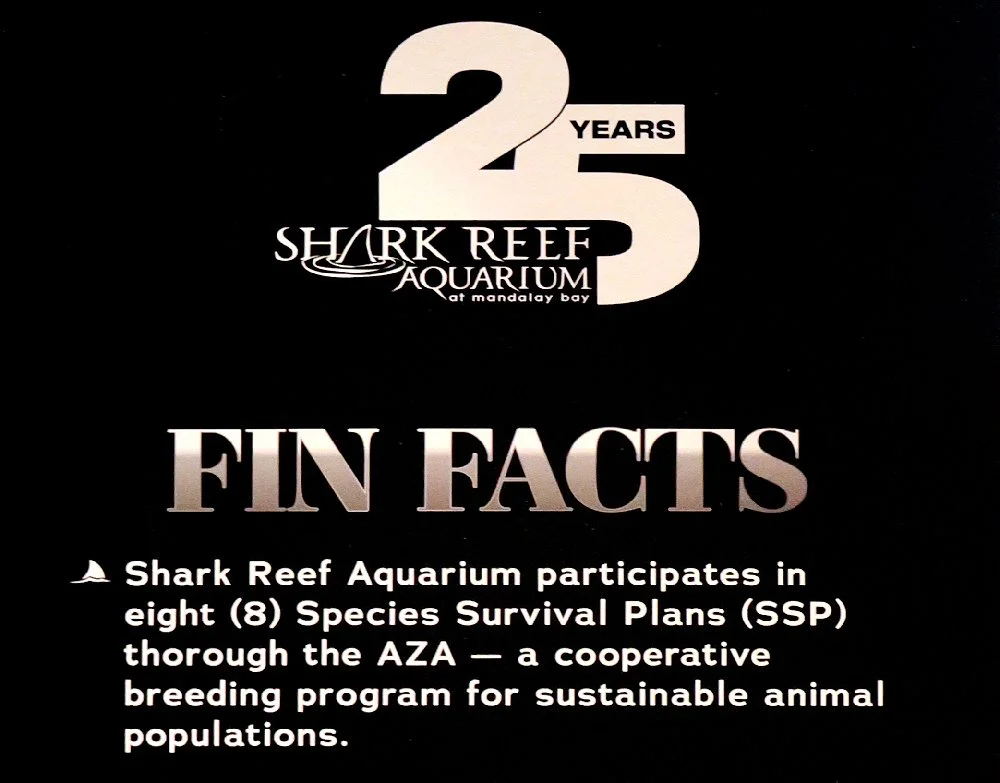
In the lobby space above where I purchase my ticket, there are multiple signs celebrating the aquarium’s twenty-fifth anniversary from last year. In addition to noting participation in eight AZA SSP initiatives, some of the other facts listed include:
Shark Reef Aquarium holds 1.6 million total gallons of freshwater and saltwater in 14 major exhibits.
Educational field trips, tours and presentations provided for more than 300,000 school kids to date.
The aquarium mixes its own seawater and has used more than 11.7 million pounds of salt since opening.
The Water Quality Lab performs daily analyses of all the exhibits and has performed over 1.5 million tests in the last 25 years.
Neptune’s Fury — The Shipwreck Exhibit is the largest tropical shark exhibit west of the Mississippi at 1.3 million gallons.
This typography overhead is the last vestige of Mandalay Bay branding present. I am about to enter another world.
The theming is not as intricate as Disney’s (it rarely is), but there is still a level of detailed paid relative to budget and craft. The cultural motifs are mixed; I am somewhere exotic, some place non-Western, but it’s not entirely clear. Here stone blocks that appear Mesoamerican are mixed with Japanese-like stone lanterns and figure carvings which could be anything from Indian Buddhist to Mayan.
Taking a nod from Animal Kingdom’s Maharajah Jungle Trek, there are ancient-looking murals above. Though the crocodile is not Audio-Animatronic, it feels similar to what you would find on Disneyland’s Jungle Cruise. Again, all the design details are vaguely exotic and non-descript.
These sealed glass doors indicate we’re in for a shift in microclimate like at so many other indoor jungles at zoos. Once again, the AZA accreditation is noted, this time on a sticker to the left.
The graphic panels I encounter are designed with what Benjamin and I call evocative theming. The large frame here with seashells at each corner is a somewhat stylized and almost cartoonish representation that matches the faux temple walls around me. There is mixture of typography, most incongruously Carol Twombly’s Trajan which is based on Roman square capitals and thus has no earthly business being here. Perhaps they were thinking of the mythical lost continent of Atlantis with its sunken ruins? Still, that story is Greek. I think it’s just a lazy design choice.
But more pointedly, what makes this panel evocative is that it still looks like we are at an aquarium (or a zoo, or a museum). The voice and appearance of the messaging is not in-world, meaning that the supposed ancient civilization that build the temple walls around me is speaking (or later, non-native explorers). The voice is curatorial; the institution is speaking: COME EXPLORE THIS ANCIENT SUNKEN TEMPLE. There is also a quote from naturalist John Muir which seems decidedly out of place in a tropical setting.
At this point the floor begins a slow descent. Apart from the ADA-mandated railings, everything is themed. At the end of some of the hallways are flat screen displays in fax stonework frames that are running a loop of facts about the aquarium. It dawns on me that during busy times, this path becomes a queue. The plastic foliage is distracting but recedes after a while and I don’t tend to notice it.
Around the next turn I glance up and see that we’re inside a large greenhouse. The kind you find all over Europe at places like Pari Daiza (Belgium), Wildlands Adventure Zoo Emmen (The Netherlands), and Zoo Leipzig (Germany). All three Benjamin and I have declared Kingdoms of Artifice, part of the seven zoos around the world that have followed closely in Disney’s footsteps.
The elaborate stone work continues, augmented by a mix of both live plants and artificial ones. The designers are clearly playing fast and loose with cultural references. This particular visage appears Thai to me, similar to the sitting Sukhothai Buddha with his elongated earlobes, but Benjamin reminds me that it actually suggests the Bayon temple complex in Cambodia. The increasing density of the tall trees, along with the humidity, really establishes a mysterious sense of place.
As the path continues to slow downward, we begin to come across the first of many animal enclosures. I counted seven total, six of which feature freshwater. At this particular ramp I realize that all the elevation gained heading up the escalators at the start is going to get shaved off bit by bit. This is a classic Disney trick—manipulating paths to distort spatial awareness. At Animal Kingdom the reverse is used from The Oasis at the entrance, with a very gradual rise that leads to a dramatic, quicker descent which, as landscape architect John Shields told us, heightens the reveal of the massive Tree of Life.
Glancing up I notice a recurring Las Vegas casino resort trope. The painted sky ceiling can be found from the Forum Shops at Caesars Palace to the entire main floor of Paris and the indoor canals of the Venetian. It’s always amusing to see where these wall planes join and the “sky” with its clouds gets distorted. They’re not fooling anybody. But out of focus, in your peripheral vision, it kind of, sort of, works.
Coming around the bend I hear the soft rustle of the first of many water features spilling over the rockwork and temple stones. The cool air around the pool is a welcome respite from the greenhouse humidity. Throughout, I was kind of disappointed that the ADA handrails were not themed, as Benjamin discovered at the Fort Worth Zoo with its wonderful habitat designs in partnership with Dunaway Associates. There you can find rails that meet code guidelines while retaining the more natural use of wood, bamboo, leather, and rope.
However, the designers did consider the sitelines above us. I spotted more than one set of running temple ramparts that really add to the grandeur of the space. Finishing the tops of things, whether guests notice them or not, goes all the way back to the original Disneyland. I also begin to notice repeated graphic patterns; here clamshells and fish line the upper lip of the wall.
I soon discover that my friendly Buddha is actually a four-sided tower, which in retrospect definitely makes me think the designers were taking inspiration from Bayon. The overall detail is impressive. Again, it’s there whether you notice it or not.
The dense mixed use of real and fake landscaping make for a real credible jungle, especially where tall trees have been planted. They encourage you to look up, where you get a real sense of the scope of the enclosure. What’s so very Disney-like is all of this is completely concealed from the rest of the Mandalay Bay casino complex. It’s the moderate, deliberately paced journey winding through that really adds to the experience.
Soon I’m inside again, where the temple ruins serve as the backdrop for a number of wildlife habitats. Benjamin and I call this form of themed presentation a dynamic show set. The structure was clearly built by some ancient civilization. Where are all the people? The animals appear to have taken over, and the spaces abandoned. As we describe in Kingdoms of Artifice:
Dynamic show sets heighten the varied and unpredictable tensions between human settlement and the natural world. The message is that the relationship between people and wild animals is complex and impermanent, with no easy answers. Conflict is ongoing, and wildlife will find ways to encroach upon us, just as we will continue to enter their ecosystems. The presentation is dynamic.
There are elaborate relief murals along the stone walls with faded pigment. Faux mold has been applied in patches everywhere.
And here is a dynamic show set as water tank. The broken columns on the exterior are continued inside the aquarium where they lie on the floor among other bits of ruins covered in moss. The temple walls continue in as well, as if the acrylic pane is a mere illusion. Half the environment is out in the air with us and the other half underwater. This set is also an example of priming, or preparing guests for what lies ahead. First we saw pools of water. That was the first tease. Now we see an actual enclosed aquarium. We must be getting closer to the main attraction.
And the path weaves out into the greenhouse again. The designers of Shark Reef were quite adept at using the architectural technique of compression and release, meaning that through a series of successive spaces, we are out in the wide open, then in a tunnel or cavern or chamber or room, and then out in the open again. Height, volume, and overall scale are constantly varied, which makes for a more interesting trek.
More aquariums now, and this time much larger. The temple ruins continue underwater as before, at full human scale. You can see an entire archway inside made of massive stone bricks.
I found this curious. At no point had we yet come across any tropical accents which take us out of this ancient, vaguely Asian/Indian/Mesoamerican temple setting. But now we have thatch roofing more at home in a tiki bar or a beach resort. Which, to my eyes, suggests an injection here of Mandalay Bay’s overall theme.
However, there is still integration with the temple walls and these portions of thatch, bamboo, and rattan. Architecturally I find this incongruous. It’s the only part of the design so far which has detracted from the immersion of the experience. It feels “made up.”
The path veers away from the wall of “tropical” aquarium viewports and continues downward. This rough lattice of timber, bamboo, and rope overhead is similar to what we have seen at other zoos. For example, at Woodland Park in Seattle, I found them everywhere. The execution is particularly strong in the indoor portion of the Tropical Rainforest (1992) area, which was designed by The Portico Group and won AZA’s 1993 Exhibit Design Award. When bamboo and rope are prominent, I call this a shipwreck motif.
Past the gateway is a looming statue of what Benjamin tells me is a Nāga. The multiple heads are unique to the Khmer culture of Cambodia, where these statues are meant to act as protective guardians. It doesn’t look like the designer’s have done much homework here, because this nāga would have traditionally been sited on a railing or near a doorway. Instead, this one acts as a pivot point as the path loops around. Not much to guard here. Despite being used out of context, the message is clear, even to a child. Wildlife can be powerful, even dangerous. And whatever ancient peoples created this icon appear to have both feared and revered this creature.
More lattices overhead which form a threshold into the next series of spaces. For the first time I catch glimpse of some small theater spotlights. These were used to great effect by Portico at Woodland Park’s Tropical Rainforest. As the Shark Reef is open until 8pm on the day I visit, and sometimes as late as 11pm, it must be pretty cool to walk through this greenhouse environment after dark. Here the temple structure rises higher than before, probably signaling the perimeter of the greenhouse and concealing the back of house areas behind.
We continue to descend through another series of switchbacks and deeper into the temple. I can imagine this path being crowded with guests waiting in line during the aquarium’s first few opening tourist seasons.
Up and to the left sits another abstracted, buddha-like (yet more Mesoamerican) figure which appears to be pregnant. Perhaps it is a fertility statue of some kind. Again, the designers were fast and loose with anything cultural. It’s vague on purpose.
At last, I reach what appears to be the final entrance to the temple proper and a departure from the greenhouse space. I did not check every sign, but so far I have seen freshwater crocodiles, Komodo dragons, pupfish, Asian arowanas, Burmese pythons, and pig-nosed turtles.
Here is the same figure again, inside yet another underwater dynamic show set. All the tanks from here on out are saltwater. The priming here is quite effective. The jungle outside is already a distant memory. It is cold and damp all around.
Suddenly up ahead a giant portal has been punched through the stone. The carvings on this wall are the same repeated patterns of fish and clamshells as I saw on the exteriors.
Enclosed acrylic walkway tubes through water like this are not uncommon at contemporary aquariums. I remember being awed by the fictional ones show at an imagined Florida SeaWorld in JAWS 3 (1983). Indeed, The real San Diego SeaWorld has them at their Shark Encounter. The first one was installed in New Zealand in 1985.
What stands out here is the thematic design. We appear to burst through the temple wall, but once I make my way across the twenty-foot span, I notice that a wall trim follows my legs at either side. We don’t leave the temple at all.
The entire attraction, including the jungle I just passed through, is home to over 100 species. Here in the central aquarium there are many kinds of sharks but also many types of fish, rays, and octopuses.
The walkway terminates at a rectangular doorway rather than a break in the wall. The same pattern of fish and clamshells lines the trim.
We are still inside this ancient temple, and in the center is the kind of touch pool common at many aquariums and zoos.
This one, however, contains ancient pottery props in addition to the expected rays.
The stonework, roots and moss wrapping around the different enclosures are remarkably credible. Just like Disney’s Imagineers, the designers here are relying on cinematic tropes. This is the kind of environment seen in the films of Indiana Jones or Lara Croft.
The credibility continues inside each aquarium, with rocks, plants, barnacles, coral, and so on.
At the far end of this space is the hull of a ship. Here two distinct environmental themes collide in an abstract manner. Every transition thus far has been gradual and considered. Not so here. We are simply expected to move, mentally, from one to another. The temple just terminates at the edge. Yet though it’s subtle, at the left there is an attempt at “blending” the two. The wall has gained a structural trim and galleon-style sconces. The stone blocks resemble the temple behind, yet everything else along this span suggests a Spanish Caribbean town of the late 1600s to early 1700s, including the doorway to, presumably, back of house. As I walk into the ship, the tears in the planking remind of how we entered the underwater tunnel.
I feel the compression immediately. The ceiling is low. The lighting is dark. There is a very quiet looping track of effects, like the sound of a wooden ship moving back and forth. You know the kind. “Harbor sounds.” I think I heard a bell at one point. Subtle yet effective. The wood planks at my feet are real. The support beams and stack of crates in the center for sitting feel more like fiberglass treated with some form of what the Imagineers call character plaster.
What’s really innovative about the aquarium walls is how the wreck of the ship’s hull continues out into the water. This provides the illusion that the acrylic—in some places as much as eight inches thick—is not here at all. All the woodwork looks correct, though it is most likely sealed fiberglass. There are barnacles. Rusted nails. Every bit of patina feels real.
The designers really got the lighting right. I’ve talked about this before within other themed spaces. It’s another Disney innovation. The sconces are credible, and the LED candlelight softly flickers.
As with the entry tunnel, the exit path is surrounded by reefs on all sides. You definitely get your money’s worth. According to one very detailed article, inside this 1.3 million-gallon saltwater tank are (on view as of 2024) Atlantic Crevalle Jack, Blue Runner, Bowmouth Guitarfish, Galapagos Shark, Green Sawfish, Green Sea Turtle, Grey Reef Shark, Lookdown, Sand Tiger Shark, Sandbar Shark, South Seas Demoiselle, and Zebra Shark.
The second tunnel connects directly back to the temple environment. Rather than breaking through the wall, there is a thick wooden doorway in character plaster. This view is looking back into the ship. Though these spaces are clearly sequential, there is nothing stopping guests from lingering or, indeed, returning and taking the path in reverse for a different perspective.
The evocatively themed panels from the entrance are back, rendered the exact same way. We’ve left the immersivity of the jungle, the temple, and the shipwreck to once again be addressed as a museum visitor. This is the strongest conservation messaging moment at the Shark Reef Aquarium. Though we’re told that YOUR ACTIONS MATTER AND YOU CAN MAKE A POSITIVE DIFFERENCE! there is no specific call to action. No way to donate money or volunteer time. Sadly, it feels like an afterthought.
When the Mandalay Bay branded wayfinding reappears, we know we are about to return to the reality of the casino. As I make my way up the stairs back to the attraction entrance, it’s evident how far we actually descended through the jungle and temple into the shipwreck. And yet it was so gradual, so expertly paced, I didn’t even notice.
There are a few last figure carvings on the wall as I ascend, these more comical than the others. Famed zoo designer Jon Coe, whom we spoke with at length for our book, would call this cartoon immersion. He insists this is not a budgetary matter, but rather an attempt at popular appeal. “People have taken the immersion idea,” he told us, but “the artificial trees, or the artificial pagoda, or whatever it is, are pure cartoons. By cartoon, I mean they’re an abstracted exaggeration of reality.”
Like so many themed experiences, the Shark Reef ends in a gift shop. The stylized metal shark forms on the railing make it clear that the immersive environment of the temple has given way to more typical retail design. I’m made aware that a portion of the proceeds from souvenir sales are donated to conservation efforts.
The Shark Reef Aquarium at Mandalay Resort and Casino in Las Vegas, Nevada, shows many signs of the influence of Disney’s Animal Kingdom, from its pacing and framing to transitions, cultural motifs, architecture, and landscaping. The exhibit is a well conceived and executed example of what Benjamin and I call evocative theming, and an subset of which Jon Coe calls cartoon immersion. If you’re in town, it’s certainly worth the visit. Take your time, don’t rush. If you linger, especially within the shipwreck, you’ll be rewarded.