Tigers, Temples, and Tropes - Part 1.
Over the last several years I have spoken with lots of people in the zoo design profession about a variety of subjects. But one I wasn’t expecting to hear so frequently about, and from so many people, was a very specific type of exhibit: the Tiger Temple. The term elicited a surprising range of responses, from enthusiastic descriptions of their favorite tiger temple to the pejorative utterance of the phrase, dismissive of it as an overused trend.
Whichever side of the fence you might fall on, the tiger temple has undeniably become a prominent element of many zoos and is probably the most common thematic design trope I have encountered at zoos.
Tigers are already dynamic and popular animals, and a well done tiger temple can create an exceptional guest magnet. My kids respond incredibly well to such temple exhibits, which probably goes a long way towards explaining their continuing popularity. For all of the potential pitfalls, the trope can create an impressive backdrop for a highly engaging story that resonates with guests.
This is going to be a multi-series post on the presentation and representation of tigers in contemporary zoos. Here I’ll first describe the design characteristics of the tiger temple, the different types of temples commonly found, and the stories those temples might tell about tigers, nature, humans, and our interconnected place on this planet. Later on, I’ll share some examples of this design phenomenon that I have encountered to explore the nuances of this trope. Lastly, I’ll discuss the other ways that tigers are often presented in zoos and wrap this all up with a typology of tiger exhibits (that should be some fun design esotericism).
As the name suggests, the tiger temple is an exhibit where a tiger is presented to the guest in a setting dominated by an architectural set piece resembling a temple. If you’ve been to a zoo in the last twenty years or so there is a good chance you have encountered this enclosure type. Normally it’s a temple, though it might also occur as a palace or fort. The temple might be ancient or modern; more frequently the former. Sometimes it is clearly tied to a region, typically the native habitat of the specific tiger species on display. Other times the styling is much more general—a generic jungle theme; something we might expect Lara Croft from Tomb Raider to be exploring. In nearly all of these exhibits it appears that humans have abandoned the site some time before. The structure is collapsing and nature is encroaching on former human habitation. Along with nature moving in, so has the tiger.
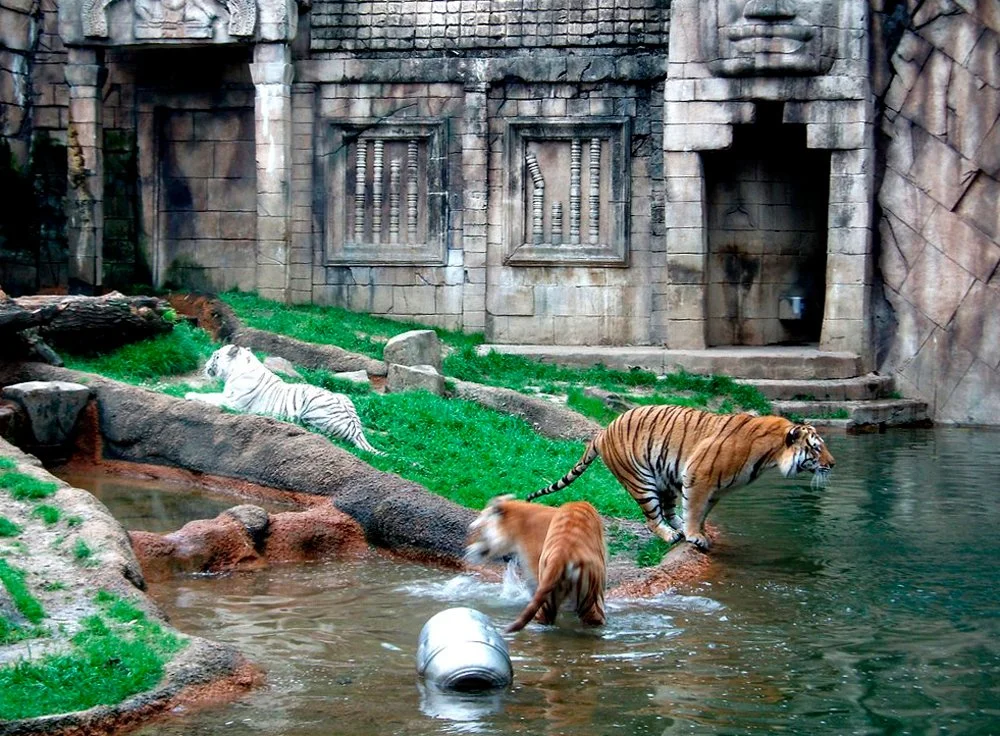
Greenslaw/Flickr
The first contemporary tiger temple that I found was the one at Cat Country in the Memphis Zoo. It was designed by Torre Design Consortium, a multi-disciplinary New Orleans design firm that has built up a large portfolio of zoo design work. Presaging what was to come, the rockwork and faux ruins were done by Larson Company, who would go on to do the work at Disney’s Animal Kingdom (DAK) later that same decade. Cat Country opened in 1993 and was the first new major animal exhibit to open at Memphis Zoo following the ancient Egypt-themed 1990 entry plaza. Across a water moat, we look into the tiger enclosure in Cat Country with an evocative background composed of a deteriorating Cambodian temple; weathered stone, crumbling architecture, water cascading over the temple. The message is clear. Nature has retaken this ruin.
Cultural elements had started making their way back into zoos just a few years before with the opening of the Asian Elephant Forest at Woodland Park Zoo, designed by Jones & Jones. That exhibit featured some modest Thai architectural theming, but it was where Grant Jones, celebrated landscape architect and founder of Jones & Jones, coined the term cultural resonance. This provided the conceptual framework to reintroduce human cultural elements into wildlife display after a near total absence of half a century.
A few years later at Memphis Zoo this idea was taken much further. And it made a splash. The exhibit was hugely popular and even Landscape Architecture Magazine, not a place that normally pays much attention to zoo design, highlighted the project. The article described the exhibit as the ruins of Angkor Wat, but the design is clearly an amalgam that draws on many ruins from Cambodia, most notably Ta Prohm and Bayon. This is the very same kind of cultural melange that Dave found at the Mandalay Bay Shark Reef Aquarium.
The tiger temple has since expanded to zoos all over the world, with many different takes on the concept. Some settings are grand, with impeccable detailing executed to the highest level, and some are more modestly designed and constructed.
Although these enclosures are commonly referred to as a tiger temple, the trope can actually take the form of several different types of structures. The important thing is that the site represents a building that is revered in some way, typically a religious structure like a temple or shrine. The tigers have moved into where monks used to reside. The implication is that the tiger is sacred and deserving of the same reverence as a religious figure.
Tiger temples can also be secular. Sometimes the tigers reside in the palace of a former king, perhaps a royal hunting lodge like at Animal Kingdom’s Maharajah Jungle Trek, or still others are a long abandoned fort. The message for guests is that nature’s largest cats should be held in respect and admiration like a great ruler from the past. Tiger temples make tigers appear regal.
How well maintained the structure is also varies. Some tiger temples look as if all the people left just yesterday and the tigers immediately moved in. The structure is immaculate and clean. The paint is fresh, the carvings crisp, and the building is structurally sound. As we sometimes find cultural artifacts still present, perhaps the tigers are sharing the space with people. This sends an interesting cohabitation message of conflict. How else would tigers be expected to be found in this type of setting? In this version, the tiger temple almost always comprises the guest viewing areas; it is what we call a guest habitat. And the tigers lurk just outside.
More commonly the structure is in a state of disrepair. The buildings in this scenario suggests the passage of time from when humans left the site. They are crumbling and weathered. The plantings have overgrown the walls, and much of the structure appears to be buried and hidden, waiting for discovery from an intrepid jungle explorer or, in a pinch, a zoo guest. In this iteration, it is very common for elements of the ruined temple to extend into the tiger enclosure, and connect with the guest areas.
In our book, Kingdoms of Artifice, Dave and I describe a taxonomy of themed zoo exhibits. Nearly all tiger temples fall into our evocative category. These spaces evoke a strong sense of place, but don’t go far enough in facilitating a suspension of disbelief. In these types of exhibits things are a little too on the nose. It’s too obvious. These spaces aren’t very credible. While I think they’re fun and my kids find them very engaging, it still feels like I am at a zoo.
This raises the subject of verisimilitude. How realistic and accurate to a place is the representation we are seeing? When we spoke with retired Disney Imagineer Joe Rohde, who was the creative lead for the Animal Kingdom project, he called these “salient details.” From Kingdoms of Artifice:
Joe Rohde calls DAK “a make-believe documentary, not a make-believe fantasy.” He finds the entire argument specious. “As a critic, what exactly are you critiquing here? I don’t like the word authentic. It’s not authentic. It’s artificial. But I do think it is accurate to the salient details [the park] seeks to represent.”
Some tiger temples clearly tell guests where they are by faithfully reproducing these details. Such exhibits succeed in transporting us somewhere beyond the zoo, but they are few and far between. More commonly the tiger temple falls into our evocative category. We can look at two examples of this side-by-side by comparing the Siberian tiger enclosure at Pairi Daiza, an adventure zoo in Belgium, with a deeper examination of Cat Country’s tiger temple.
Pairi Daiza’s enclosure was built on a scale where all of the stylistic elements could be presented in their fullness. I find the bas-relief depicting the churning of the milk sea creation story depicted in a long hallway in near perfect recreation to the original I encountered several years earlier in Siem Reap.
A tower, adorned with faces, nearly approximates in both scale and representation the actual faced-temple of Bayon.
And the interior courtyards that the tigers inhabit are built at a scale that is believable. I’ve been to Cambodia and explored these ruins, and I could be forgiven if I believed I was visiting again.
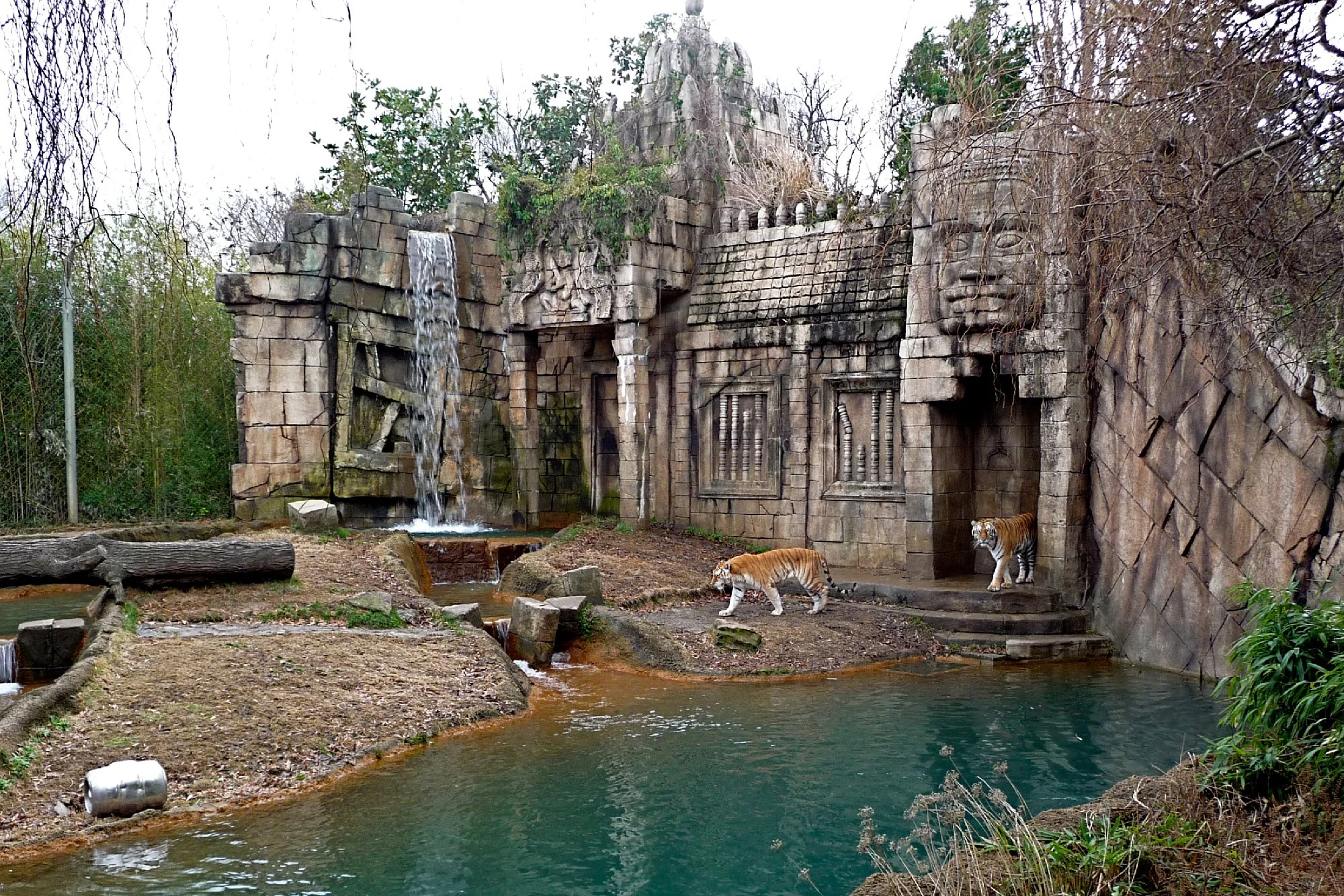
Brad Coy
Cat Country has no pretenses about fooling you into thinking you are actually in Southeast Asia. This is established at the start when you pass through a red torii gate, a common trope used for anything Asian, despite being Japanese. This tendency to combine elements extends to the tiger temple itself, which feels like a blend of every possible Khmer architectural motif. This is an exaggerated set piece that is more Broadway stage than Angkor Wat. And that’s not bad; this isn’t a quality judgement. It’s a stylistic choice.
Disney’s own version, however, is exemplar. Unrivaled in its design context and details, this temple is actually an old hunting lodge for bygone Mughal kings. The architecture throughout the guest areas comports perfectly with what we might expect from a royal Indian estate. The walls are decaying and, in so doing, reveal the actual construction of the palace. As plaster breaks and falls away we see the bones of brick and wood. Scalloped archways frame views into garden courtyards that double as the tiger enclosures. Ornate frescos are depicted on themed, sculpted surfaces which the Disney Imagineers call character plaster. The artwork is highly authentic to its time and place. Below us are cracked pavers or concrete made to look like dirt. This is theming in totality. Probably the ultimate tiger temple, for now.
At some other zoos there is little attempt to re-create reality. The designers tried to conjure a feeling, or atmosphere, but it is nowhere in particular. For instance, the tiger temple at Lisbon Zoo is a tumbledown ruin with ambivalent architectural styling that suggests little. We could conceivably be in India, Southeast Asia, or even Mesoamerica. Somewhere tropical inhabited by an ancient civilization. The site gives off lost city vibes, like Dave found at the Shark Reef Aquarium. Atop the gateway to the temple a tiger statue stares down at us, a somewhat comical place marker that feels a little too exact.
Why are there so many tiger temples…and why temples in the first place? I think there are several reasons why this type of theming is deployed. First and foremost, people like it. The best tiger temples, like at DAK, feel transportive. They place us where the tiger lives, this is especially effective for designs with high levels of verisimilitude. It feels exotic and adventurous and takes you out of the humdrum steel and glass cages and endless cookie-cutter homes that define most of our urban environments.
A good tiger temple can ground you in a place and make it feel like you have stumbled upon a site that has always been here. That the tiger has always been here. Going into one of these exhibits creates excitement for guests. It’s unfamiliar and we are free to discover, imagining ourselves as an explorer for National Geographic or cosplaying as Indiana Jones.
While visiting countless tiger temples, I’ve observed that young people respond especially well to them. The theming is an easy way to telegraph a message and a meaning, to embed and contextualize educational content and make it feel less like we are being talked at by the interpretive material. Tiger temples provide avenues to tell cultural stories and provide a seamless opportunity to educate and connect the guest with the tiger and the local people who live in daily contact with these big cats.
There are several common stories, messages, and themes that I’ve seen in these exhibits. As I mentioned above, implicit with putting the tiger in a temple is a message of reverence or respect. The cat stalks the passages where priests and kings once strolled. We should respect the tiger in the same way that past societies revered their leaders. They also suggest the impermanence of society and the resiliency of nature. In some ways, this is a melancholic notion of hope and humility for all of us. And of course, a major reason there are so many tiger temples is because zoo designers, and the zoo directors they serve, like to copy each other. It’s a tale as old as time in design. Any model shown to be popular and effective is bound to be copied. It’s the ultimate compliment to the tiger temple that there are so many of them. They work.
