Welcome
Welcome to the start of our research blog! For more than six years, the two of us—Dr. Benjamin H. George (Associate Professor, Utah State University) and Dave Gottwald (Associate Professor, University of Idaho)—have been collaborating on papers and presentations about themed spaces. Our interest began by exploring cinematography in the landscape and how designers leverage the grammar of film editing in spatial design at the Disney parks.
At some point, we began to become more interested in zoo design and themed exhibits at contemporary zoos. Benjamin clearly remembers where it all began for him—Utah’s Hogle Zoo in Salt Lake City. Not surprising for a landscape architect, he’d been a zoo enthusiast since childhood.
Benjamin
I have always loved animals. As a child I would pour over National Geographic magazines and watch The Living Planet with David Attenborough (BBC, 1984) multiple times a year, so I was naturally drawn to zoos in my youth. In fact, I often would sit in the pews at church and—while the sermon was being given—happily draw out plans for my own zoos. These looked very much like what I saw as a kid—elephants in a circular enclosure here, monkeys climbing on structures here, lions sitting on concrete rocks over there. And paths encircled all the enclosures, ensuring that my fictional visitors could see the animals everywhere and always.
Growing up in the Bay Area, I recall going on a field trip to the San Francisco Zoo and it feeling more like a grand city park. It certainly didn’t feel exotic. I remember concrete moats with water and animals hanging out on grass and concrete floors. Other animals were behind bars or fences. At the time, that’s what I thought zoos were—places where animals were kept in a park-like setting.
I also remember a family trip to the San Diego Wild Animal Park (today the San Diego Zoo Safari Park) and the thrill of riding the Wgasa monorail and seeing the big savannah and watching giraffes and other animals roam. The park felt different, but as a ten-year-old you don’t really think deeply about why that is.
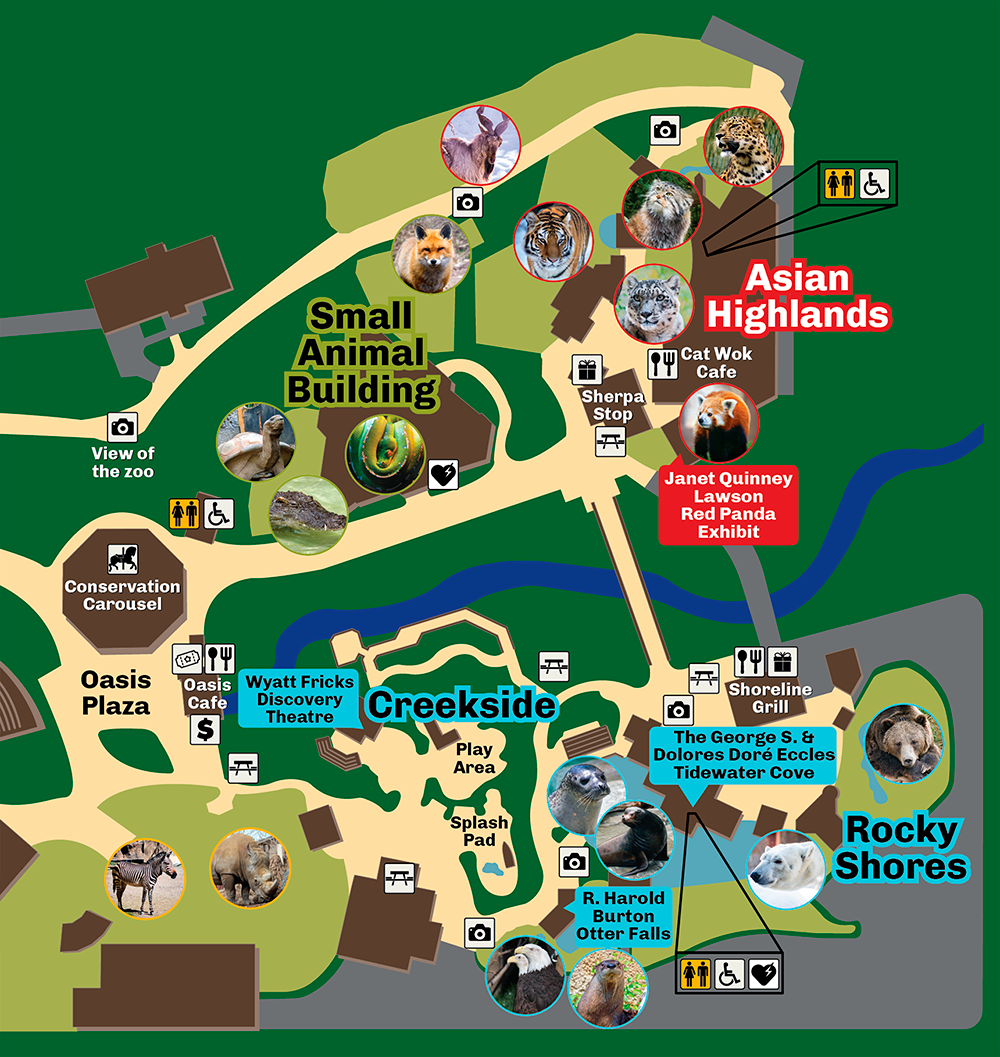
Map, eastern end of Utah’s Hogle Zoo, Salt Lake City.
When I visited Utah’s Hogle Zoo I had probably not been to a zoo in two decades. I was more mature now, I was a father with my own children, and I had a degree in landscape architecture. This visit to the zoo surprised me. Things were different. Something about the design of zoos had profoundly changed in the intervening decades.
The entrance belied this change, it was straightforward with a fairly nondescript entry plaza and the expected typical “zoo architecture.” After taking the kids for a ride on the Conservation Carousel, another oldie but goodie, however, things took a sudden and unexpected thematic turn.
When I entered the Asian Highlands (2006) area, it seemed more like Disneyland than the zoos I remembered from my youth. The environment felt a little bit like I had walked into that park’s Adventureland, if Adventureland was in the Himalayas.
Instead of modern buildings and bars I found structures that seemed to be crumbling with time and the hallmarks of Himalayan cultures and designs. Rock cairns and haphazard retaining walls, rough hewn and irregular timber, sun-dried bricks and slate rock.
Glancing to my right, I saw lattices overhead of raw logs and leaf vines crawling up the sides of a towering roof of Chinese glazed tiles.
All around me there were crumbling walls of mixed brick styles, as if the local population had made do with whatever they could find. Everything appeared incredibly old and weathered.
Asian Highlands, Hogle Zoo, plan view. Illustration: Dave Gottwald.
I soon passed into a cluster of houses arranged around a small village square. Nothing felt like it was conceived by the hands of an architect. Things were just built, as I presume many structures would be in this part of the world.
I still noticed the requisite zoo infrastructure—wayfinding, a fire hydrant, power conduits. Still, I somehow felt transported away from Utah.
Walking deeper into the village I would encounter bridges that looked like they were meant to carry local vehicle traffic, yet this one only carried the 400 pounds of Amur Tigers.
The architecture was Asiatic and bespoke; nothing generic in sight. What had happened to the zoo of my childhood? This seemed much more theme park than wildlife park.
Everywhere there were signs of human habitation. It looked like an entire population lived here. But other than fellow zoo visitors and the animals, there were no locals to be found. It’s like everyone stopped what they were doing and had stepped away to tend to livestock or fields. Surely they would be back at any moment.
What Dave and I would later discover is that this addition to the Hogle Zoo strongly resembled the fictional village of Serka Zong at Disney’s Animal Kingdom which coincidentally opened the very same year along with the Expedition Everest - Legend of the Forbidden Mountain themed roller coaster.
Hogle had many similar details, all the way down to the weathered Nepalese prayer flags strewn overhead. Looking closer, I saw that some had writing and illustrations on them. The designers had paid attention to the details.
We had come to Asian Highlands to see one animal in particular: the Amur Tiger. At first I was afraid my children would be disappointed because we couldn’t find the tigers in the lush vegetation that filled the enclosure. Then I suddenly discovered one was, in fact, crouching right in front of me, a testament to how effective their camouflage is.
The big cat was very carefully watching a little girl nearby. He clearly saw her as a potential snack! As such, being in such close proximity served as an educational moment about the danger and strength of these wild animals.
In that moment, it really felt like a tiger was prowling outside this little Himalayan village I had wandered into. The sense of immersion was overwhelming. It was like being inside a story, inside of a narrative environment. Quite like what I’d often felt at the Disney parks. But like nothing I had ever experienced at a zoo.
By the time I had explored the adjacent Rocky Shores area just to the south, I began to suspect that Disney must have had some sort of influence on contemporary zoo design. All of this couldn’t just be a coincidence.
Having grown up in the Bay Area, Rocky Shores seemed to me a salient representation of a coastal wharf and cannery operation like I had seen on visits to Monterey. Even the dining and retail establishments all mimicked the vernacular architecture I had seen on visits to the northern California coast.
We watched seals, sea lions, and polar bears swim around and bask on rocks from within industrial buildings complete with corrugated metal siding and monitor roofs. I seemed to have left the Salt Lake City and had stepped into an early twentieth-century seaside fishing community.
Gone were the concrete moats, the flat grass enclosures and, what had been even worse, the concrete pads. But why? This experience led me to start a journey, one that Dave and I are still on with the publication of this blog.
Dave
I have vivid memories of visiting the Santa Ana Zoo on grade school trips. It was the closest to where I grew up in Southern California, about halfway between Los Angeles and San Diego. I recall it was quite small (it’s less than half the size of Hogle, about twenty acres). And I remember the same impressions that Benjamin had of the San Francisco Zoo—it was artificial with a lot of concrete.
I also visited the San Diego Zoo, San Diego Wild Animal Park, and SeaWorld on vacations with my family when I was growing up. All three seemed Disney-adjacent to my child mind, but not because of their designs. Because of their attractions. The Wild Animal park had its monorail, of course, and both SeaWorld and the San Diego Zoo still have their Von Roll aerial trams, the Bayside Skyride and Skyfari, respectively. Sadly, Disneyland lost its in 1994. You can read about all three gondolas at Werner Weiss’s wonderful Yesterland site.
Unlike Benjamin, however, it wasn’t a zoo that got me thinking about the theming of wildlife display. It was Disney’s Animal Kingdom itself. I first visited the newly opened park in January 1999 on a trip with my father and marveled at the Imagineers’ unrelenting attention to detail.
The Asia portion of the park had not yet opened. I remembered them testing the Kali River Rapids attraction which was scheduled to debut that March.
Everywhere I looked, I saw amazing architecture, props, and signage. It felt so incredibly authentic. I didn’t know it yet, but this was because the Imagineers took repeated research trips across the globe to see the people, the animals, the structures, and the landscapes of other countries.
For example, the above temple ruin, used as a Gibbon habitat, is closely based on one the design team found in Indonesia. As a result, I still think Animal Kingdom is the most intricately and elaborately themed Disney park in the United States.
When I returned in the fall of 2007 on a trip to Walt Disney World with a friend, I was actually there to document the resort’s parks for my MFA thesis project, Themerica. There was much more to see; Asia was not only open but also newly expanded. Here are the sketchbook entries from my visit:
Themerica travel journal, Animal Kingdom overview, 2007.
During these park trips, I would note my exact route on the paper map to help me recall the events of the day. I took notes on small pocket-sized notebooks that I then later collaged into spreads along with new notes and sketches.
Themerica travel journal, Expedition Everest and queue area, 2007.
I came away thinking Animal Kingdom was the coolest zoo I had ever experienced. Still, I hadn’t put two and two together yet. With my thesis project (which today lives on as the Themerica blog) I looked at theme parks, amusement parks, hotel resorts, retail, and dining from Disneyland to Dubai.
But aside from the Shark Reef Aquarium at Mandalay Bay in Las Vegas, which I visited in July 2008, I had completely ignored themed wildlife displays. Once Benjamin started visiting and documented zoos around the world during his academic sabbatical in 2021, a pattern began to emerge. Practically everyone was following in Disney’s footsteps, theming both the guest areas and the animal habitat enclosures.
Kingdoms of Artifice
The result of this investigation is our first book, Disney and the Theming of the Contemporary Zoo: Kingdoms of Artifice. The ebook PDF and hardcover are now available for pre-order from Bloomsbury Academic, Studies in Disney and Culture, and will be released September 3 and October 1, 2026, respectively.
We’re going to use this research blog to expand upon everything we couldn’t possibly include in that tome, from detailed site analysis of themed zoo exhibits worldwide to extended commentary from practitioner interviews. All augmented by copious photography. This will be a home for our musings on Disney’s tremendous influence on the zoo design profession and Animal Kingdom’s indelible and ongoing legacy within the field of wildlife display.